Fillworks LLC has submitted new, supplemental materials to St. Louis County regarding its proposed project to fill the inactive Ruprecht Quarry. This provides more information on traffic and environmental impacts, and it also outlines Fillworks’ regulations while working on the site.
These materials were submitted to the county’s Department of Transportation and Public Works and the Department of Public Health for engineering and environmental evaluation.
Fillworks’ complete package of information is tentatively scheduled to be presented to the St. Louis County Planning Commission for consideration at its executive meeting on Nov. 9. According to the county, this target date is tentative and may be adjusted.
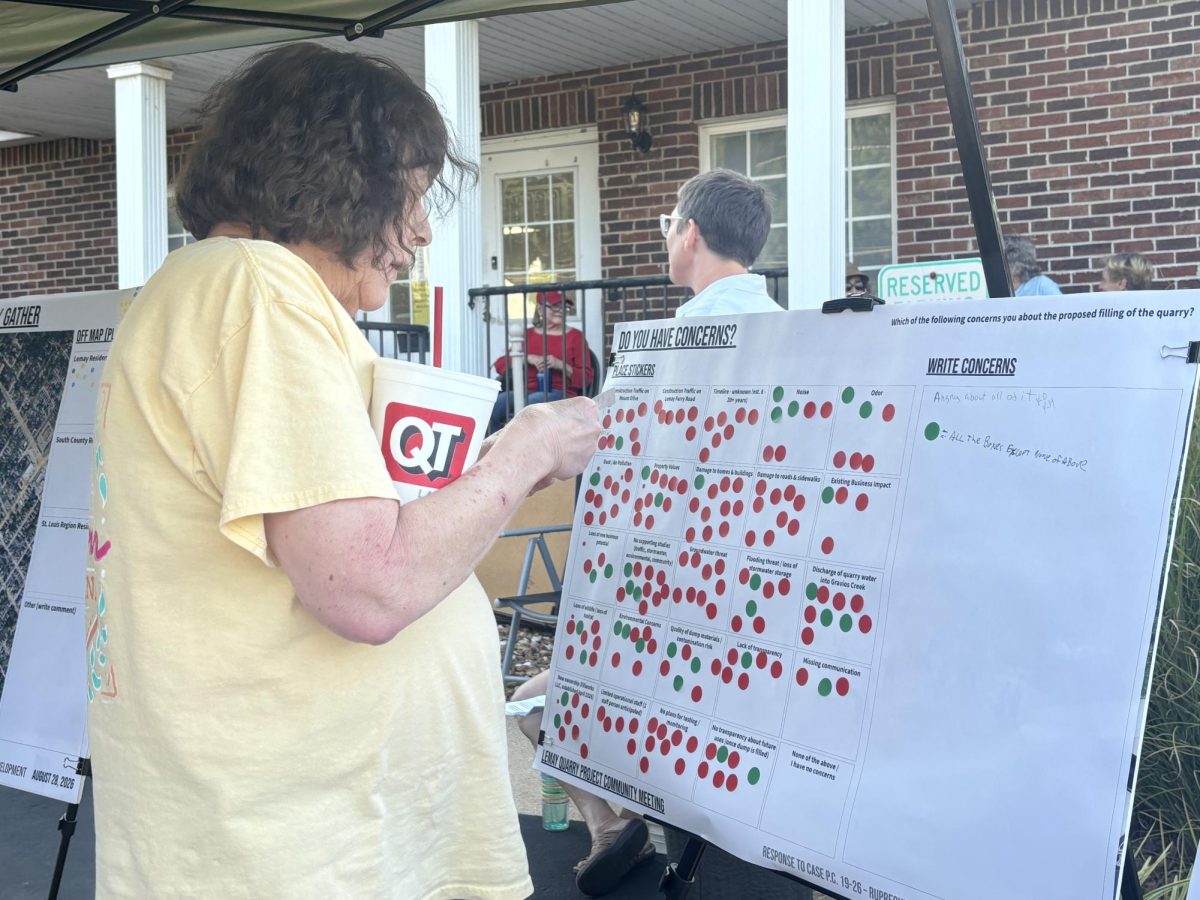
The proposed project would fill the inactive 30-acre Lemay quarry with “clean fill.” Initial estimates said this project would take over a decade to complete, with construction crews at work six days a week. Residents of the surrounding neighborhoods have been staunchly and vocally against the project. To read more about this project and neighbors’ reactions, see prior reporting online at callnewspapers.com.
Operations
One concern raised by neighbors is the number of trucks driving through small, residential streets, in and out of the quarry site. According to the new materials, Fillworks anticipates an average of 100 to 150 trucks coming in and out per day.
At a rate of 150 trucks per day, carrying 10 cubic yards of cleanfill materials per truck, Fillworks now estimates being able to complete the project in 6.41 years. At the lower end of the scale, with a rate of 100 trucks per day carrying the same amount, Fillworks says the project could take 9.61 years.
Fillworks cited two comparable projects for their calculations. The Green Park Quarry — also 3 million cubic yards — took 13 years to fill (1991-2005) with an average of 74 trucks per day, carrying 10 cubic yards per truck. Meanwhile, the Des Peres Quarry — twice the size of the Ruprecht Quarry at 6 million cubic yards — took 20 years to fill (1995-2014), with an average of 96 trucks per day, carrying 10 cubic yards per truck. Both projects also had six-day work weeks.
Materials
Fillworks also included information about what materials will be used in the cleanfill site. Accepted materials include “uncontaminated soil, clay, sand, gravel, rock, asphaltic concrete, concrete free of contamination, cinder blocks, bricks and vac truck materials demonstrated to meet MDNR (Missouri Department of Natural Resources) clean fill criteria.”
Prohibited materials include “municipal solid waste, yard waste, construction and demolition debris containing contaminants, petroleum-impacted soils, asbestos-containing material, hazardous waste, special waste, sludge, chemical waste, drums, liquids, putrescible waste, tires, batteries, roof shingles and any material not meeting clean fill requirements.”
Concerns have circulated amongst neighbors about the materials going into the quarry. Resident Chris Eckstein previously told The Call that he was worried about a lack of monitoring on what materials are in the trucks being dumped into the quarry.
At a meeting of concerned neighbors on Aug. 28, State Rep. Michael Burton of District 92 said, “The fact that Fillworks LLC first wanted this to be a dumping site for construction and the (Department of Natural Resources) told them no, and now they say they want to fill it with clean fill, gives me great pause.”
Fillworks says that, to ensure appropriate materials would go into the quarry, there will be several safeguards put in place as part of a “compliance plan.” The plan includes a master service agreement, which establishes a contractual responsibility to deliver only accepted materials; time-stamped camera imaging to catch the inbound truck; and inbound driver load certification forms, which record key information for each load, confirming that the material comes from appropriate sites. There will also be visual inspections by staff and random samplings of the truckloads, Fillworks says.
Interested parties have until Oct. 23 at 5 p.m. to submit written comments to the St. Louis County Planning Commission regarding this proposal. Staff and reviewing agencies will then compile a comprehensive technical analysis, agency findings and a draft recommendation for the commission.
If the Planning Commission votes to recommend this project for approval, the St. Louis County Council will have the final say whether to approve or deny at a later date.