


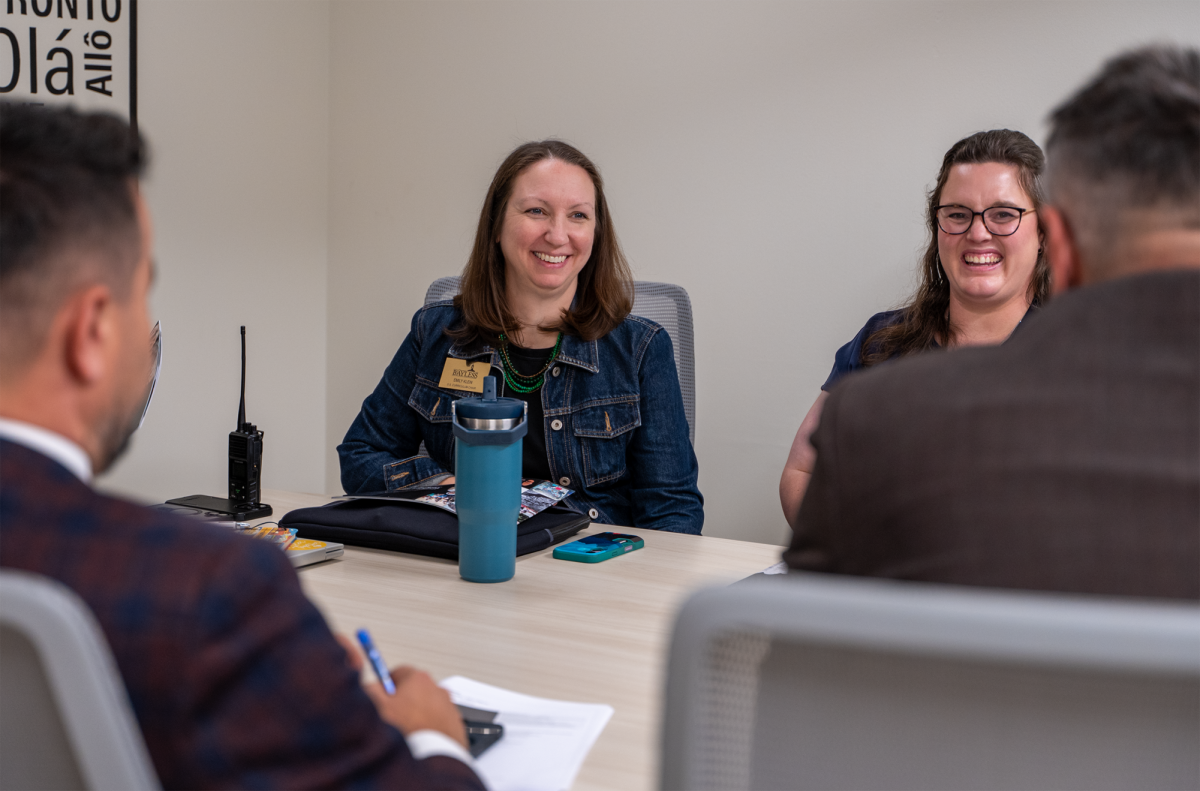
Representatives from the Srebrenica Memorial Center — located in Srebrenica, Bosnia — recently visited Bayless and Affton high schools to talk with students and staff. They discussed the Srebrenica genocide, which took place in 1995, with teenagers enrolled in high school Bosnian-American Studies courses. A group of students in history or free-period classes also attended.
“What they’re seeing is that history is not something in the past,” Brian Jennings, Affton High School’s Bosnian-American Studies teacher, said. “It’s something living and current and present. The truth of that history is a somewhat contested area, particularly in Bosnia, and it takes heroic people like those working at the Memorial Center to really stand up for truth. It’s just incredibly important to see people doing the work of preserving and archiving the truth, promoting the truth. It’s something we want our students to be a part of.”
In July 1995, more than 8,000 Bosniak (Bosnian Muslim) boys and men in the town of Srebrenica were slain by Bosnian Serb forces, and more than 20,000 civilians were expelled from the area. The genocide was described as “the worst episode of mass murder within Europe since World War II.”
Affton and Bayless both have high populations of Bosnian students; St. Louis itself is home to more Bosnians than anywhere else in the world, outside of Bosnia itself. Many of them settled in South County neighborhoods.
Jennings says he was grateful that representatives were able to talk to students from these schools. While Jennings’ Bosnian students are intimately familiar with the history of the Srebrenica genocide — even so far as having family who survived the event — other students in his class had never heard of it before.
In addition to having representatives from the Srebrenica Memorial Center visit Affton and Bayless, Jennings and Bayless teacher Emily Klein will get the chance to visit Bosnia in December and attend the program “Learning From Srebrenica: History, Memory and the Teaching of Genocide.”
To Jennings’ knowledge, approximately 30 to 35 people from across the globe were invited on the trip; he says that he and Klein may be the only two representing the U.S.
“It’s always been on my wishlist, but it’s expensive to get there,” Jennings said. “As a teacher, I always start the class by saying I don’t speak the Bosnian language fluently and I’ve never been to Bosnia. I have to change that next year, which is totally crazy. The community has brought so much to us to be able to go there. (…) It’s an incredible opportunity that I really never even imagined. Such an honor.”
Klein added, “I am incredibly honored to have been invited, and grateful to have the opportunity to learn and work with educators from twenty other countries. I am very much looking forward to my first visit to Bosnia and Herzegovina, and I can’t wait to share everything that I learn with my colleagues and students when I return.”
The trip will include a day in Bosnia’s capital of Sarajevo, where Jennings and Klein will attend a tour of the city. After that, they can look forward to a few days at the Srebrenica Memorial Center itself, attending several presentations.
“They’re really interested in strengthening the relationship with us here in St. Louis because we have such a connection with the (Bosnian) community,” Jennings said. “They’re really about how they can take all the resources there and start sharing those out.”
Jennings hopes that this opportunity will go beyond an educational trip; he intends to take resources and information back to the U.S. with him afterward, not only to use in his classroom, but to share with other educators. One way this might look is beginning to develop a state curriculum for Bosnian-American Studies courses — Missouri currently does not have a mandated statewide curriculum.
“I’m going in with the idea that, when I get back, I’ll be an ambassador for sharing those resources and making sure schools — not just around St. Louis, but also around the country — know that they should teach about this,” Jennings said. “They should teach about the work that’s happening and that resources are available for them to do that.”
The trip will take place the week after Thanksgiving. Jennings says there are tentative plans in the works for another trip in spring — if that came to pass, teachers as well as Affton students enrolled in the Bosnian-American Studies course would be able to fly to Bosnia.
“It would make (students) part of the process of coming back, sharing what they have learned — the possibilities are endless,” Jennings said.
