

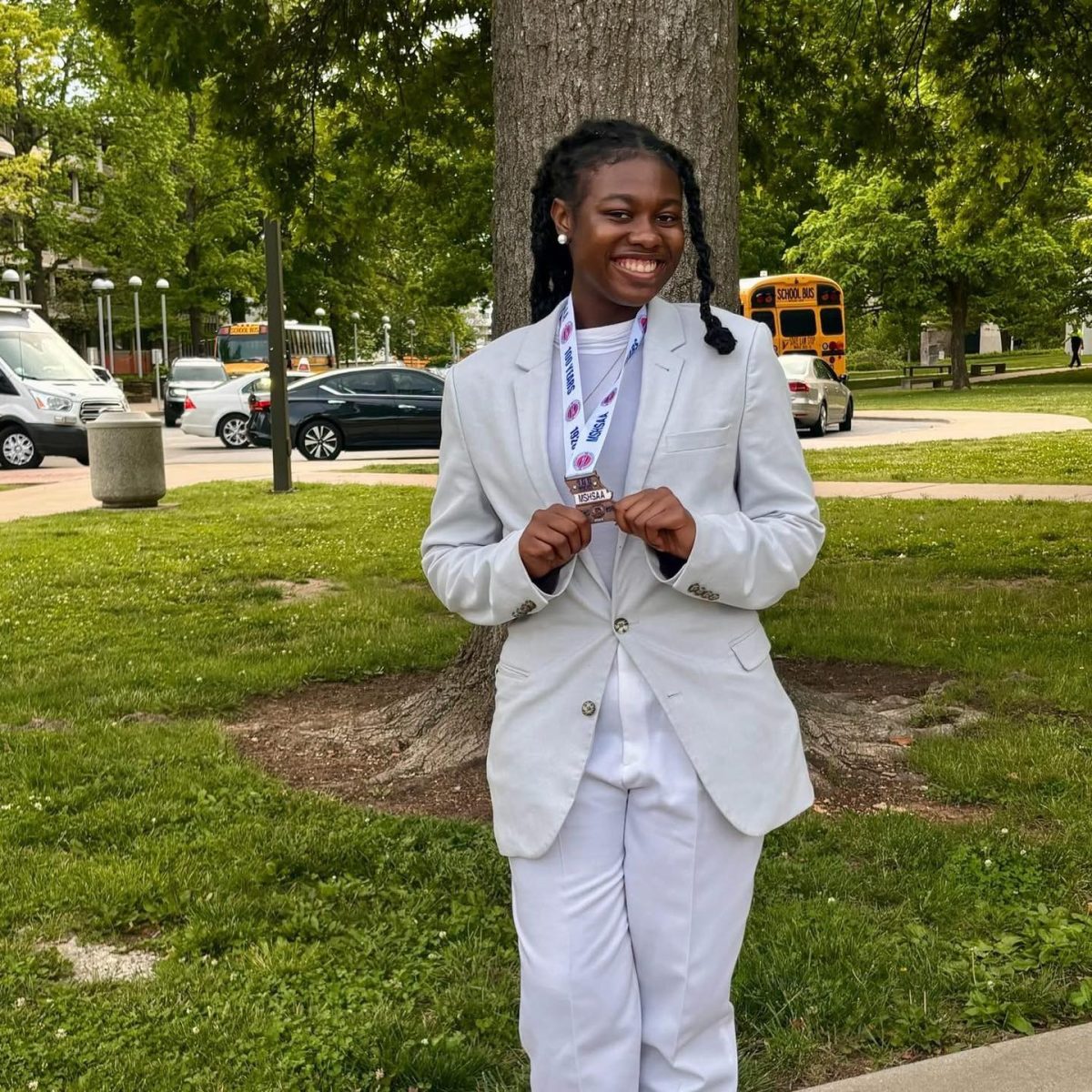
When Lealua Naabien took the floor at the MSHSAA Speech and Debate State Championship, she strove to keep power in her voice. The Affton High School junior read three poems for the judges’ consideration, but her coach Julie Bayha says it wasn’t just a poetry reading — it was a performance.
“The event is called Poetry Reading, but it’s not just standing there and reading a poem,” Bayha said. “You can see the emotion in her piece. You can see the passion she has for the topic when she performs. She has movement, and she changes her voice. She really captures the audience.”
By the end of the competition, which took place on April 24-25, Naabien walked away with the third-place title in the Class 1 Poetry Reading category. This marks the first time in recent history that an AHS student has competed at the state level in speech and debate.
“I felt proud of myself,” Naabien said. “I felt accomplished to have made it there.”
Naabien selected three poems about the Ogoni people — a group that lives in the Niger Delta region of Nigeria. Her own family is Ogoni, so the poetry Naabien read was close to her heart. The first poem she read was a personified piece about the beauty of Ogoniland, which has suffered from oil extraction and numerous oil spills.
The second poem was titled “The True Prison” by Ken Saro-Wiwa, a leading Ogoni writer and activist, and the third was titled “A Tribute to Ken Saro-Wiwa” by Michael Oluwasegun.
“I chose poems that honored the Ogoni people, and through that, I continued to learn more about my culture,” Naabien said. “I had searched for Ken Saro-Wiwa, who is the hero of Ogoni. I know him as a poet and a writer. My dad has his books in his office, and I’ve read a lot of his work. I knew that was where I was going to find my center source, and then from there, I also found different poems speaking about Ogoni, and speaking about Ken.”
The inspiration for Naabien’s poetry reading started with an essay she wrote for her AP English Language and Composition class. She was asked to pick a topic to write about and chose the Ogoni people. Naabien says that, because she was “in that mindset” of thinking about her culture, she chose Ogoni-centered poems for the competition.
“This happens to a lot of children of immigrants — sometimes your parents don’t teach you the language, they don’t teach you certain things that you want to know,” Naabien said. “I don’t even know my language, because they didn’t find the time to teach us. But every time we go to events, they always say to the children, ‘You need to know the language. You need to take on the culture. You need to be moving with the movement.’ But we don’t know the stuff that we need to know about it. So (my poem selection) derived from that.”
Naabien qualified for state by placing in the top four at the district competition. At state, she went through three rounds of the competition before finally being named the third-place winner.
“I felt emotional, because I was connected to the experience. I tried to make sure I always kept a power in my voice, because that’s what the Ogoni people do. We’re a people of pride. We’re a people of strength. We’re a people of resilience. That’s what I wanted to represent when I was presenting myself, especially because that was probably a lot of people’s first introduction to the Ogoni people.”
For Naabien, an essay for school and a poetry reading competition kicked off a new drive to learn about her culture. She says she’s been pursuing it with renewed fervor.
“This past year, I’ve definitely asked my dad more questions about our culture, and I’ve also started to learn the Ogoni language,” Naabien said. “Although my parents don’t have all the time in the world, I’ve been trying to initiate more. ‘Hey, teach me. What is this word? What does this mean?’ And starting the conversation.”
