


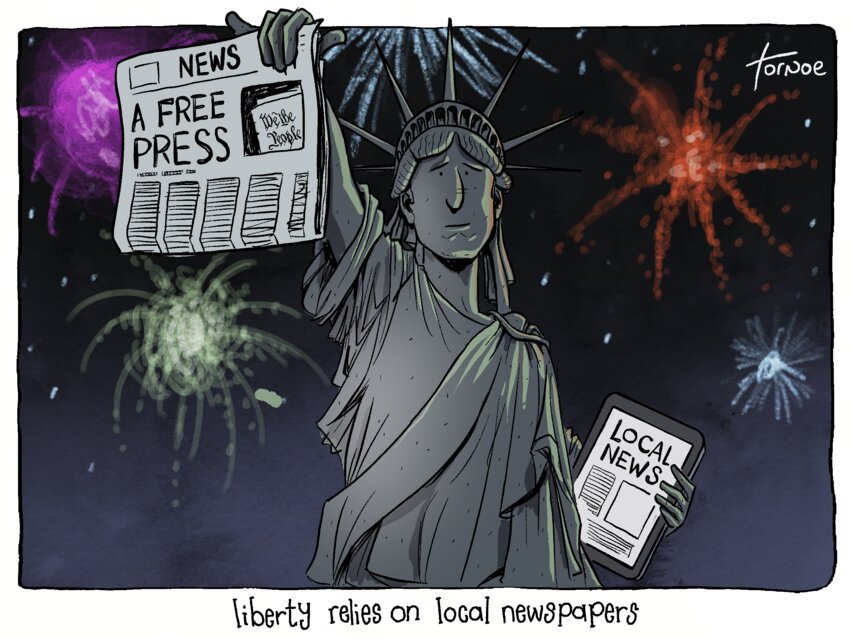
Two hundred fifty years ago, the Declaration of Independence was adopted in Philadelphia. But America did not become a country only in that room. It became a country as the news moved from community to community. Most colonists did not witness the debates of the Continental Congress. They learned about independence through the newspapers that served their towns and colonies.
On July 6, 1776, the Pennsylvania Evening Post became the first newspaper to publish the full text of the Declaration. Newspapers throughout the colonies soon followed. The Declaration was written for a nation, but it reached people one community at a time.
That is an important distinction. The Declaration changed history because people read it. They read it in the places where they lived and worked. They discussed it with neighbors. They considered what independence would mean for their families, businesses, farms, churches and towns. A national declaration became a local story.
Local newspapers helped Americans see themselves as part of something larger. They did not simply carry words from Philadelphia. They carried a question to every community: What does this mean for us?
That role did not end with the Revolution. As the country grew, newspapers continued to connect national moments to local lives. They carried arguments over the Constitution and the direction of the republic. During times of war, local papers published the names of hometown soldiers who enlisted, were wounded or never returned. During periods of economic hardship, they reported where work could be found and which neighbors needed help. They recorded national triumphs and tragedies on the same pages that covered local government, new businesses, community milestones and high school football.
Local newspapers have always done more than report what happened. They create a shared record of public life: what was decided, who was affected, what comes next and what questions still need to be asked. They do not ask communities to agree on everything. They help communities understand what they are talking about.
That work matters today because national decisions still become real locally. A new law affects a nearby hospital. A state budget changes what happens in a classroom. A vote at city hall determines how tax dollars are spent. A zoning decision reshapes a neighborhood. National news can tell people what happened. Local newspapers tell them what it means at home.
The way news is delivered has changed, and local newspapers have changed with it. Whether in print, by email, on a website, through an app or on social media, the essential work remains the same: putting reliable information into the hands of people who need it to understand and participate in their communities.
As America marks 250 years of independence, this is not simply a moment to look back at the role newspapers played in the country’s founding. It is a moment to recognize the role they continue to play.
It is also a moment to sign on.
Through SignOn250, Americans across the country are being invited to add their names to a replica of the Declaration of Independence. This is a simple way to be a part of something bigger: a public way to recommit to the principles it set in motion. Signing on is not a partisan statement. It is a civic one. It says liberty still requires participation. Self-government still requires informed citizens. And communities still need people who read, listen, question, debate, vote, serve and stay informed.
For 250 years, local newspapers have helped carry that work from one generation to the next and from one community to another.
America started as local news. Local newspapers delivered it then, and they are still delivering it today.
Visit SignOn250.org to add your name to the Declaration of Independence and take your place in America’s next chapter.
Dean Ridings is president and CEO of America’s Newspapers and can be reached at dridings@newspapers.org.
