


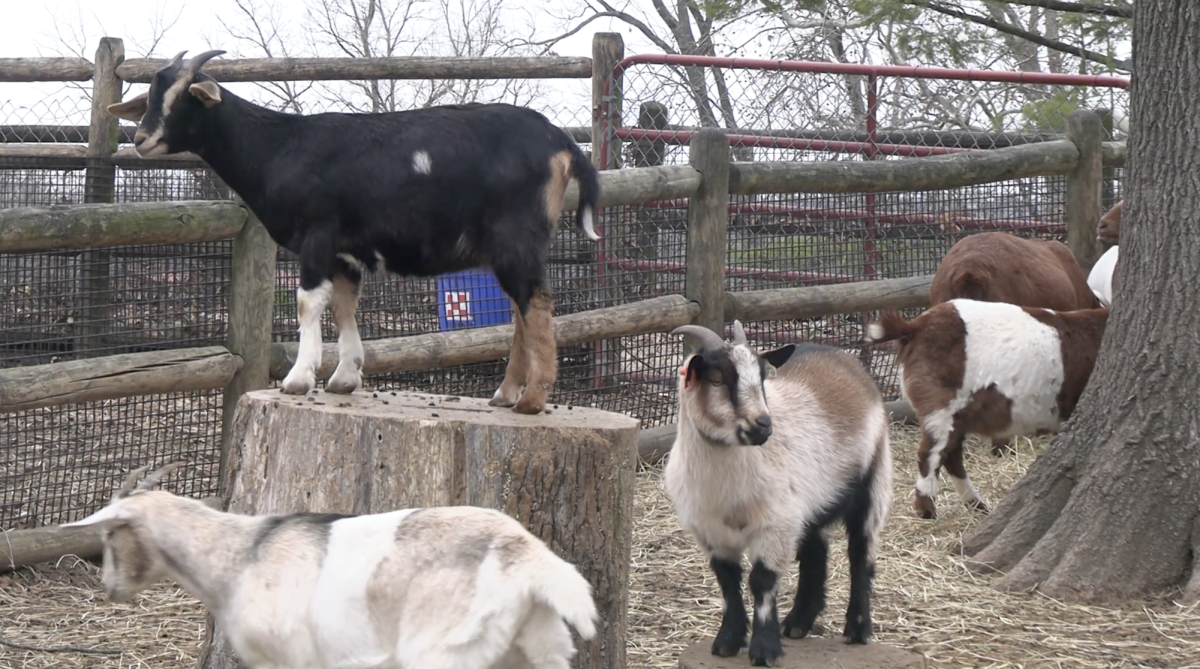
On Tuesdays and Thursdays, you might notice a cooler left outside Sappington Elementary School. This cooler is filled with leftover food: peppers, carrots, apples, broccoli and more. If you watch the cooler long enough, you might see a truck from Grant’s Farm drive by, pick it up, and whisk it just up the road.
This is the new collaboration between Sappington and Grant’s Farm, which launched this past October. The school and the farm are right next door to each other — passersby on their way to Sappington might see animals marching alongside the fenceline. It’s been a long-time dream of Sappington staff to work with Grant’s Farm due to the proximity, and that dream has finally come to fruition through a food waste reduction project.
“We have food waste, constantly, in the cafeteria,” assistant principal Stephanie Werner said. “That’s been a concern for a long time for numerous members of our team. (Grant’s Farm) said, ‘Well, we can take some of that scrap food, and that can be a supplement or an enrichment for the animals.’ So that’s what we’re doing.”
The leftover food goes to feed the many animals who call Grant’s Farm their home. Werner, who coordinates the program, says Sappington donates five to eight pounds of food to the farm each week. The food is brought over in the cooler twice a week; occasionally, representatives from Grant’s Farm will reach out to ask for more of a specific type of leftovers, or they might say, “Less lettuce.”
Not only does Grant’s Farm get free food for the animals, but students will get to learn more about the farm; Werner hopes to put together an announcement that has the name and a photo of one of the animals they feed. In the future, kids might even get to meet the animals.
“We want this to shift from being adult-centered to student-centered,” Werner said. “How are they seeing their impact on the real world, based on what they’re learning in class? It makes it all connected and more meaningful.”
For now, Sappington is just seeing how this program works. The next step, Werner says, will come during the next school year when staff and faculty begin integrating it into curriculum. This could look like older students tracking food waste reduction for math assignments, or using the Grant’s Farm animals to kickstart research projects about animal habitats. The idea is to start with the older students, until it can be incorporated into the younger grade levels.
In the future — if things go well at Sappington, and if Grant’s Farm actually sees continuous benefits from the collaboration — this program might see expansion in the district, though nothing has been formally discussed.
“We can go from just focusing on engagement of students in the classroom to talking about empowerment and ownership of their learning,” Werner said. “If we can make science in our everyday life relevant to students … It’s incredibly empowering to them.”